
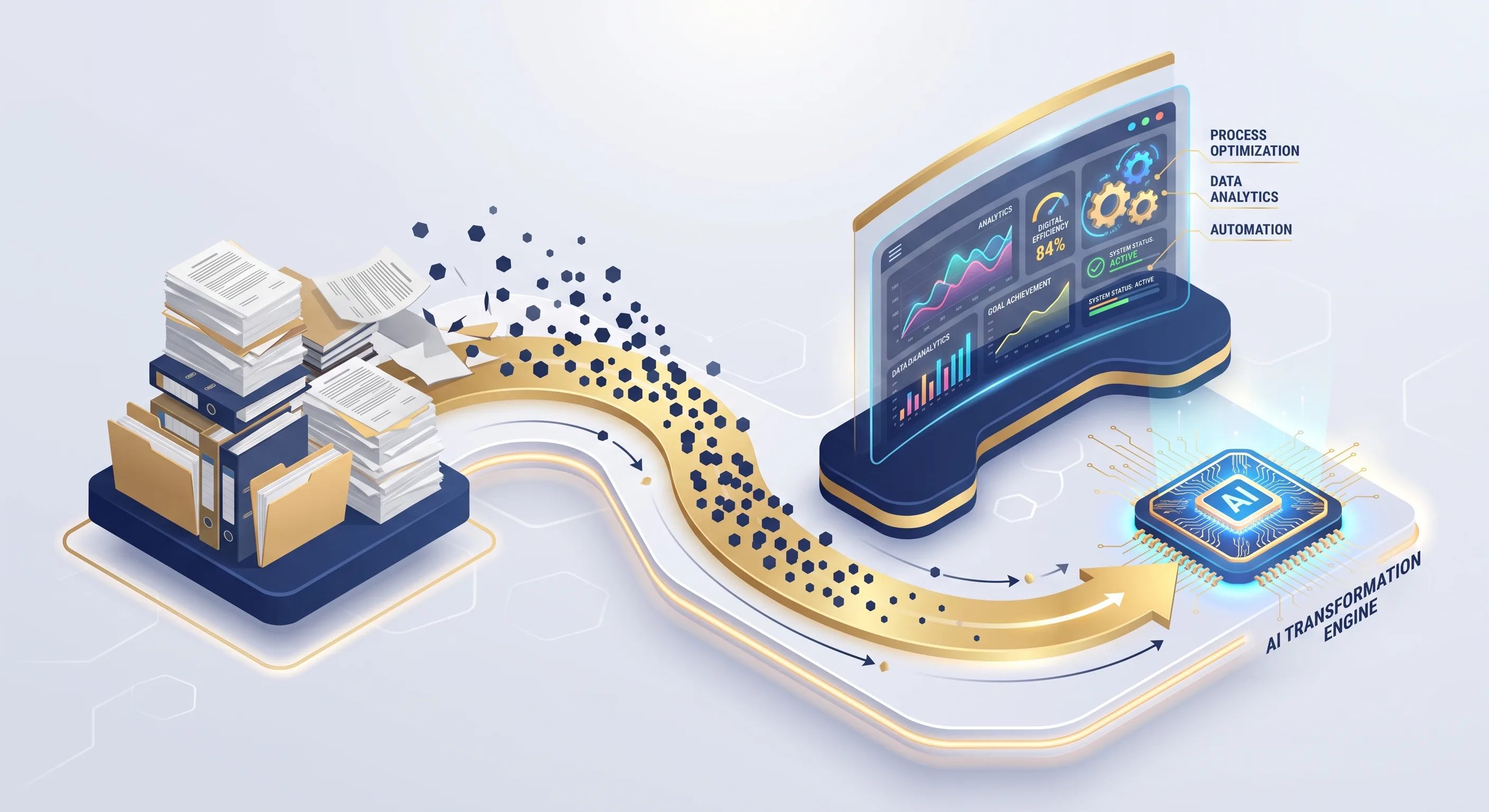
Digital transformation for a small or medium business means moving core operations from paper and scattered Excel sheets into connected systems: a CRM for sales, an ERP or accounting and inventory system, e-invoice integration, and then automation of repetitive tasks. Start by diagnosing your biggest operational problem, and roll out one system in phases before expanding.
Where do you start? How do you diagnose your current situation?
Before buying any software, map how each department works today: who enters data, where it is stored, and who relies on it. A diagnosis shows where time and money are really lost, so you choose the system that solves your problem rather than the most popular one. Useful questions:
- How many times is the same data entered in different places, such as an order written in a notebook, then Excel, then the accounting software?
- Where do customer orders and inquiries get lost, and how long do replies take?
- How long does it take to prepare a sales report or an inventory count, and who can see it?
- Which data lives only on an employee's phone or notebook and disappears if they leave?
- Which procedures need a manager's approval and stall when that manager is away?
Rank the problems by their impact on revenue or cost, and pick one or two for the first phase.
Which systems do most growing businesses need?
| System | Problem it solves | Sign you need it now |
|---|---|---|
| CRM for customers and sales | Tracks every lead from first inquiry to closed deal, assigns it to a sales rep and sends follow-up reminders | Leads from ads and WhatsApp get lost, or you do not know which rep follows which customer |
| ERP or accounting and inventory system | Connects sales, purchasing, inventory, accounts and branches in one database | Stock balances do not match reality, or accounts are collected manually from each branch |
| E-invoice and e-receipt integration | Issues the invoices required by the Egyptian Tax Authority directly from your system | Every invoice is entered twice: once in your software and once on the tax portal |
| Workflow automation | Runs repetitive steps automatically: creating shipping labels, sending confirmations, low-stock alerts | Staff copy data between systems or send the same messages every day |
| Website or online store and app | Sales and self-service channels: ordering, booking and order tracking | Customers call to ask about things they could check themselves |
To understand the difference between the two core systems, read ERP vs CRM; for e-invoicing, see integrating e-invoicing with your system. The tasks worth automating first are covered in business process automation.
On sales channels: a website or online store brings in new customers through search and ads, while a mobile app is most useful for customers who buy or book repeatedly, because it enables notifications and quick access. Do not start with an app if you do not yet have returning customers.
What does a 12-month digital transformation plan look like?
Timelines vary with company size and data readiness, but splitting the work into quarters prevents trying to change everything at once:
| Phase | Goal | Deliverables |
|---|---|---|
| Q1 (months 1–3) | Diagnosis, documenting current procedures, cleaning scattered Excel data | A unified customer and product list, and a CRM for sales |
| Q2 (months 4–6) | Connecting accounts, invoicing, inventory and purchasing | An ERP or accounting and inventory system, with Egyptian e-invoice integration |
| Q3 (months 7–9) | Automating customer service and opening direct sales and service channels | An online store or customer portal, and automated WhatsApp replies to recurring questions |
| Q4 (months 10–12) | Data-driven decisions | Management dashboards for sales, inventory and collections |
If you also sell in Saudi Arabia, add the e-invoicing requirements of the Zakat, Tax and Customs Authority (ZATCA) to Q2.
Off-the-shelf software or custom systems: how do you choose?
Start with off-the-shelf software when your processes are standard, such as general accounting or a point of sale for a single shop, and you need no complex integration. Consider a custom system when the way you work is itself a competitive advantage, when you need to connect several branches, sales reps and systems, or when you pay for multiple subscriptions that do not talk to each other. The full comparison is in off-the-shelf vs custom software.
Snaabble provides a tailored technical assessment to define the right stack & exact budget.
An example of this kind of system in our portfolio is FoodFlow, a food distribution management platform that brings together sales, purchasing, cash collections, inventory and approvals, with apps for sales reps and managers and reports.
How should you plan the budget?
There is no single number that fits every business, because cost depends on the number of users and branches, the volume of data to migrate and the number of systems to integrate. What you can control is how you plan:
- Pay in phases tied to clear deliverables, not one lump sum for a vaguely defined project.
- Count recurring costs: hosting, licences and subscriptions, support, SMS and WhatsApp messages, and updates.
- Set aside budget for training and data migration, the items most often forgotten when comparing quotes.
- Keep accounts and data in your company's name: domain, hosting, app store accounts and the database.
For a detailed estimate of a custom system, see custom ERP cost.
Why do digital transformation projects stall, and how do you avoid it?
- Staff resistance: involve the people who will use the system in its design, and train them before launch, not after.
- Software that does not fit how you work: test the system against real scenarios from your business before signing.
- Old, messy data: a new system with duplicated, wrong data just moves the same chaos to a newer screen.
- Launching everything at once: start with a pilot in one department or branch, then roll out after fixing the feedback.
- No internal owner: appoint someone inside the company who owns project decisions and works with the developers.
How do you know the transformation worked?
Before you start, define indicators to measure before and after the new system, such as:
- Time from receiving an order to delivering or shipping it.
- Time to respond to a new customer inquiry.
- The gap between system stock balances and physical counts.
- Time to issue an invoice or the monthly sales report.
- The number of orders or invoices that need manual correction.
What else do small business owners ask about digital transformation?
Do we need a full in-house tech team?
Not necessarily. Development and hosting can be outsourced, but you need an internal person who understands the business and makes decisions, plus system documentation and full access to your data and accounts so you are not tied to a single developer.
Should we start with an online store or a mobile app?
Usually with the website or store, because it appears in search and receives ad traffic directly. Move to a mobile app once you have customers who come back to buy or book regularly. The detailed comparison is in PWA vs native app.
Is e-invoicing mandatory for my company?
The Egyptian Tax Authority has rolled out its e-invoice and e-receipt systems in phases and by taxpayer category, so confirm your company's status with the authority or your accountant, and read integrating e-invoicing with your system.
Does digital transformation mean cutting staff?
The goal is to remove repetitive work and errors so staff can focus on customers, sales and follow-up. Some manual data entry may no longer be needed, but the clearer benefit is that the same team handles more work without new hires for every increase in orders.
Snaabble is a software company based in Talkha, Dakahlia, Egypt, that develops custom business systems such as ERP and CRM, as well as automation solutions. To discuss the first phase for your business, contact us on WhatsApp at +20 103 673 3131 or at hello@snaabble.com. Our address is on the location page.